Pros and Cons of Being a Carpenter

See if you qualify for Carpentry programs
Answer a few questions in 2 minutes. Free, no commitment.
For the right person, carpentry is a strong career. You can be paid while you train, the median wage sits well above the typical U.S. job, and a quarter of carpenters run their own operations. The costs show up in your body and your schedule: the work is physically hard, injuries are a real risk, and weather or a slow economy can cut your hours. Whether it is a good career for you comes down to which of those trade-offs you can live with.
The Short Version
What works in your favor | What works against you |
|---|---|
Paid apprenticeships instead of tuition | Heavy lifting, kneeling, and awkward positions |
Median pay of $60,580 (May 2025) | Strains, falls, and other job-site injuries |
No college degree required | Outdoor work in heat, cold, and rain |
A clear route to self-employment | Apprentice wages at the start |
Many specialties, from framing to cabinetry | Your own tools and, if self-employed, business costs |
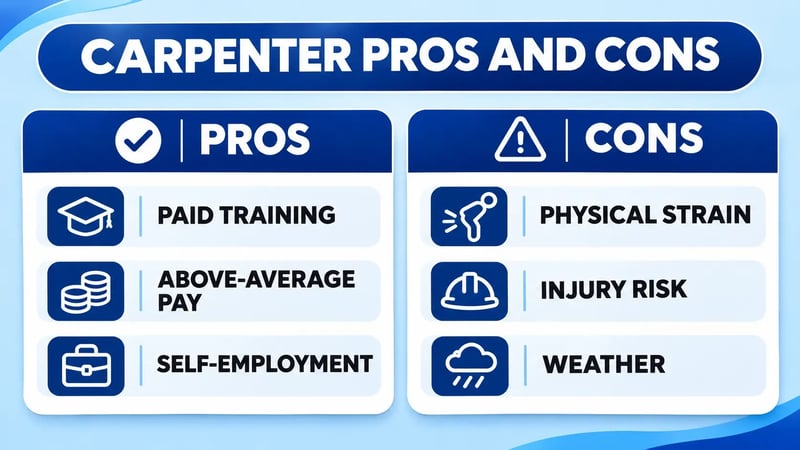
The Pros: Why People Choose Carpentry
Training that pays you
Most carpenters learn through an apprenticeship, and apprentices are employees. Instead of paying tuition, you collect a paycheck, and raises arrive as you progress. Union programs publish pay schedules that rise every year of training, and our breakdown of how long carpentry training takes shows one program's year-by-year figures.
Pay that beats the typical job
Carpenters earned a median of $60,580 in May 2025, compared with $50,980 across all occupations, according to the Bureau of Labor Statistics (BLS). The type of construction makes a modest difference: carpenters in nonresidential building construction had a median of $63,780, while those in residential building construction earned $60,600. Geography matters far more. Hawaii ($85,280), Illinois ($79,000), and California ($75,920) had the highest state medians. Can a carpenter make $100,000 a year? The top 10 percent earned more than $99,910, usually by working in high-wage markets, supervising crews, or running a business.
No degree, no student debt
Employers typically look for a high school diploma or GED, not a college degree. Because apprentices earn wages, plenty of carpenters reach full skill without borrowing for school. For the step-by-step version, including license rules in each state, read how to become a carpenter.
A ladder beyond the tools
Carpentry doesn't have to mean swinging a hammer forever. BLS notes that experienced carpenters can move into lead carpenter, first-line supervisor, or general construction supervisor roles. The same union training institute lists average earnings of $72,485 to $97,010 plus benefits for foremen and $98,100 to $131,018 for superintendents, depending on the area. Those jobs trade some physical work for planning, scheduling, and managing crews.
A real shot at being your own boss
In 2025, 25 percent of carpenter jobs were held by self-employed workers, more than any single industry employed. Remodeling, repair, and finish work lend themselves to small independent businesses.
Work that keeps coming
BLS projects about 62,800 openings for carpenters each year from 2025 to 2035. Most come from carpenters who retire or change careers, which means steady demand even though overall employment is projected to grow at an average pace.
Room to find your niche
Some carpenters love the scale of commercial concrete forms. Others prefer the precision of stairs, trim, and custom cabinets. The trade is wide enough to let you specialize in the work that suits you, and the skills pay off at home too.
The Cons: What Are the Downsides of Being a Carpenter?
The biggest downsides are physical. Years of lifting and kneeling take a toll, and injuries are a real risk. Income can also swing with the weather and the economy, and apprentice pay starts low.
The physical toll
According to BLS, carpenters often work in cramped spaces and alternate constantly between lifting, standing, and kneeling. Years of that strain show up in backs, knees, and shoulders. Technique and good equipment help, but this is never a desk job.
Injury risk
Is being a carpenter dangerous? It carries real risk. BLS lists strains from lifting, falls, slips, trips, and contact with tools or equipment among the common injuries. Hard hats, boots, eye protection, and safety training reduce the danger without removing it.
Weather and economic swings
Outdoor carpenters work through heat, cold, and rain, and bad weather can delay projects and shorten hours. Construction also follows the economy, so a slow winter or a downturn can mean less work and a thinner paycheck.
Deadlines that spill into your evenings
Most carpenters work full time, and BLS notes that schedules can stretch into evenings and weekends to meet clients' deadlines. Bad weather can also shift construction timelines, which pushes some of that work into longer days.
Lean early years
Why do some people call carpentry low paying? Mostly because of where everyone starts. Apprentices and helpers earn well below the median, and some states pay far less than others. Oklahoma ($46,910) and Arkansas ($47,760) had the lowest state medians in May 2025.
Tools and overhead
BLS notes that many employers expect carpenters to supply their own tools. Go independent and you also cover insurance, licensing, a work vehicle, and the unpaid hours spent on estimates and paperwork.
A changing job site
Factory-built wall panels and modular sections reduce some of the on-site work carpenters once did, BLS notes. The skill still matters, but the mix of work is shifting.
How the Trade-Offs Balance Out
Paid training vs. a slow start. You avoid tuition, but you accept lower pay for the first few years. If you can budget around an apprentice wage, that can be a better deal than borrowing for a degree.
Independence vs. overhead. Self-employment is common and can raise your income, yet it adds licensing, insurance, and the business side of the work. Plenty of carpenters stay with an employer for exactly that reason.
Steady demand vs. uneven hours. Openings stay plentiful year after year, but your personal workload can still rise and fall with the seasons and the local economy.
Fast entry vs. slow mastery. You can start earning almost immediately, yet an apprenticeship usually lasts three to four years, and the speed and judgment of a veteran take longer still to build.
Is Carpentry a Good Career for You?
You will probably enjoy the work if you like building things you can see, are comfortable with measurements and angles, and would rather earn while learning than pay tuition first. It may frustrate you if you have back or knee problems, want a fixed indoor schedule, or need a high income from day one.
The trade is open to anyone who completes the training. Women made up 3.1 percent of employed carpenters in 2025, according to BLS survey data, and registered apprenticeships must follow federal equal opportunity rules.
If the upside wins out, the next step is finding training that fits your schedule. You can compare carpentry classes near you on Dreambound.